
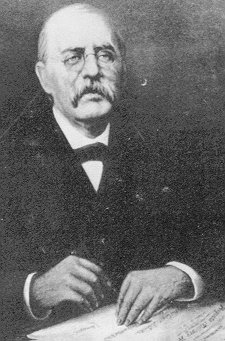
When Charles Summerville Roller died in August of 1907, he was known as one of the most successful teachers of his day. His legacy is ours — the Augusta Military Academy and all that it stands for.
In addition to his scholastic qualifications, he possessed rare abilities as an administrator and had few equals as a disciplinarian. His success was based in part on his genial disposition and his high estimate of his profession as a teacher, and he was always an active contributor in his community.
Origins & Education
Charles S. Roller was born 8 May 1839 in Mount Sidney, Virginia, the oldest of seven children of Jacob and Margaret Roller. Four of his siblings died before their fifth birthday, so he grew up with two brothers.
There were no public schools in Augusta County before the Civil War, and Charles received his early education at local private schools, including the Mossy Creek Academy. He attended the University of Virginia for two years, 1859–1861.
The mapmaker who shaped a friendship
Jed Hotchkiss was principal of the Mossy Creek Academy when Roller attended classes there. Hotchkiss later served as General Thomas J. Jackson’s Civil War topographical engineer.
He and Charles Roller maintained a lifelong friendship, and Hotchkiss delivered the commencement address at AMA on June 1, 1898.
The War Years
On 24 July 1861, three days after the First Battle of Bull Run, Roller enlisted as a private in the Confederate forces at Fairfax Court House. He joined General J. E. B. Stuart’s 1st Virginia Cavalry Regiment.
The Valley Rangers fought throughout the war. On 8 April 1865, Roller was thrown by his horse, captured, and made a prisoner of war. The following day Lee surrendered to Grant, ending the war in Virginia.
VMI cadets marched past
Over 250 cadets from the Virginia Military Institute passed through Ft. Defiance on 13 May 1864, just a few feet from the land eventually to become the home of Augusta Military Academy.
Homecoming & the First Classrooms
Parts of the Shenandoah Valley had been devastated. Homes, barns, livestock and crops were destroyed, and there had been no educational opportunities for young people for four years.
In September of 1865, Roller joined C. M. Packer as a teacher in the school at the Augusta Church. Beginning in September of 1866 he became Principal of the Old Fort Academy.
In 1871, Roller was elected to the Virginia State Legislature, where he served on committees of education, schools and colleges.
The Academy Takes Root
In 1874 he moved his school to a newly erected frame building and the name became Augusta Male Academy. That same year Charles Roller married Rosabelle Moorman.
By the 1879–80 session, half of the thirty students came from outside the local community. A program of military instruction was adopted by 1880, making Roller’s one of the first military preparatory schools in Virginia.
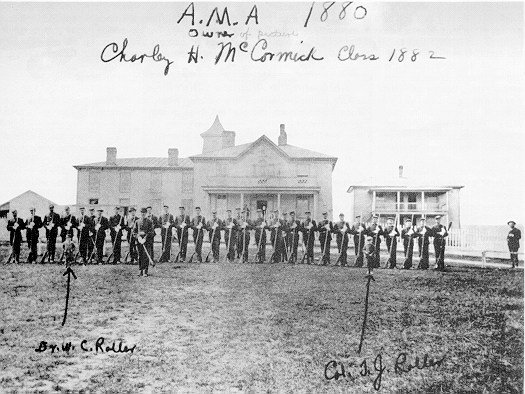
Life in the Frame Barracks
In the 1880s, life in the original frame barracks lacked the conveniences of later years. Rooms held two boys and a single small wood-burning stove. Beds were wooden frames with rope springs and corn-shuck mattresses.
Saturday was woodchopping day. Saturday nights belonged to the Literary Society, devoted to debate, elocution and declamation.
Beginnings among the old, tall trees
AMA began in a building that once stood in the churchyard of the Old Stone Church, one of the most historic structures in the Shenandoah Valley.
The Professor
The 1880s curriculum spanned Greek, Latin, French, German, English, U.S. History, geometry, algebra, elocution, physics, literature and surveying.
Roller taught daily. An imposing figure, he was also very nearsighted. To his students he was known as “The Professor” or “The Old Boss.”
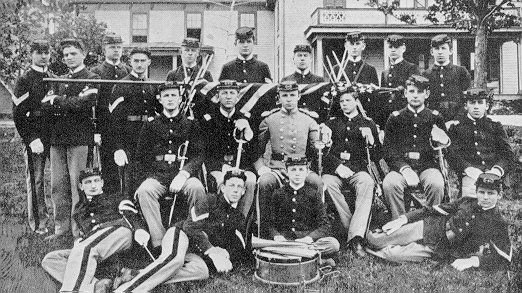
Augusta Military Academy
During 1888–89 the Professor renamed the school the Augusta Classical and Military Academy, and by 1890 it had become simply Augusta Military Academy.
The Academy celebrated its 100th anniversary in 1965, dated to the beginning of the Professor’s teaching career in Ft. Defiance in 1865.
After his funeral on 28 August 1907, a newspaper reported that the cortege passed over the spot where Roller first taught. That was indeed the seed from which grew that beloved school.